Abstract
The materials used in dining tables and chairs not only determine their appearance but also influence durability, maintenance requirements, and overall user experience. A piece of dining furniture is typically composed of core materials, surface finishes, and structural components. This article introduces common furniture materials, including solid wood, MDF, particle board, plywood, honeycomb board, veneer, PVC finishes, glass, marble-effect surfaces, upholstery fabrics, foam padding, and metal frames. It aims to help consumers understand different material characteristics and choose suitable dining furniture based on their specific needs and lifestyles.
Keywords
Dining Table; Dining Chair; Solid Wood Furniture; MDF; Dining Table Materials; Dining Chair Materials; Particle Board; Plywood; Furniture Surface Finishes; Upholstery Materials; Furniture Durability
Introduction
When purchasing dining tables and chairs online, consumers often focus first on colours, textures, and overall design. However, the visible appearance of furniture does not always represent its internal construction. A tabletop with the same wood grain appearance may be made from solid wood, MDF, particle board, plywood, honeycomb board, or composite materials. Similarly, upholstered dining chairs with a similar look may use foam with different densities and resilience levels. Therefore, evaluating the quality of dining furniture requires more than looking at its appearance; it is important to understand the materials, structural design, and intended usage environment.
Core Material Comparison
Compare common furniture materials to understand their features, benefits, limitations, and best uses.
Material | Characteristics | Advantages | Limitations | Common Applications |
|---|---|---|---|---|
Solid Wood | Directly processed from natural timber with unique grain patterns | Natural appearance, can be sanded and refinished, good tactile feel | Affected by humidity, may shrink or crack, hardness varies between wood species | Dining tables, chairs, premium furniture |
MDF (Medium Density Fibreboard) | Made by compressing wood fibres, providing a smooth and uniform surface | Smooth finish, suitable for painting, laminating, and various shaping processes | Limited edge impact resistance, moisture may cause swelling if the surface is damaged | Panel dining furniture, cabinets |
Particle Board | Made by compressing wood particles with adhesives | Lower cost, suitable for mass production | Edges are easier to damage, moisture exposure may cause swelling | Affordable furniture |
Plywood | Made by bonding multiple layers of wood veneer in alternating directions | Stable structure, strong, suitable for curved designs | Quality varies significantly, lower-grade products may have weaker performance | Chair backs, shaped furniture |
Honeycomb Board | Uses a layered surface with a honeycomb core structure | Lightweight, suitable for large furniture and easier movement | Limited load-bearing capacity in concentrated areas, connection points require reinforcement | Lightweight tables, cabinets |
Common Furniture Materials Explained
Solid Wood
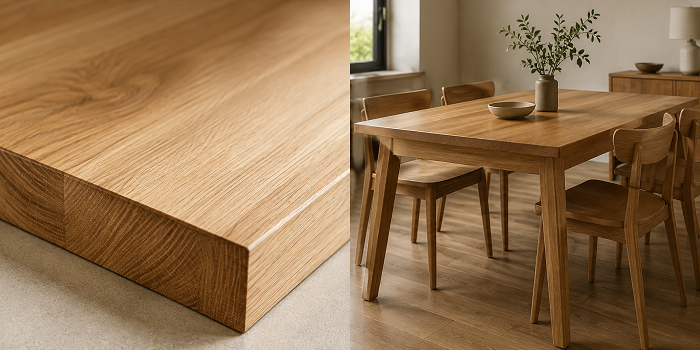
Solid wood is made by directly processing natural timber and features unique grain patterns and natural colour variations. Common types of wood used in furniture include rubberwood, pine, and oak. Its advantages include a natural feel, the ability to be sanded and refinished, and rich visual depth. However, solid wood can be affected by humidity, which may cause shrinkage or cracking, and different wood species vary in hardness and durability.
MDF (Medium Density Fibreboard)
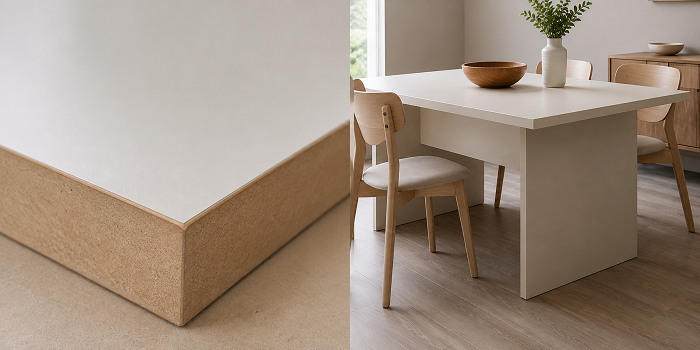
MDF is manufactured by compressing wood fibres with adhesives under high pressure. It offers a smooth surface, easy processing, and is suitable for finishes such as paint and decorative films. However, its edges have limited impact resistance, and if the surface coating is damaged, moisture can enter the material and cause swelling.
Particle Board
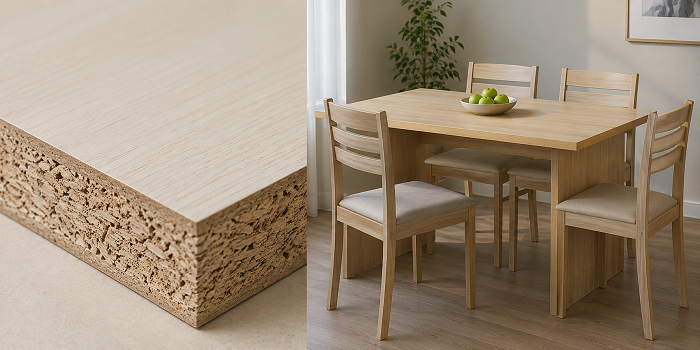
Particle board is made by compressing wood particles and adhesives together. It offers advantages such as affordability, efficient use of raw materials, and suitability for large-scale production. However, its long-term performance depends heavily on edge protection, edge banding quality, and connection design.
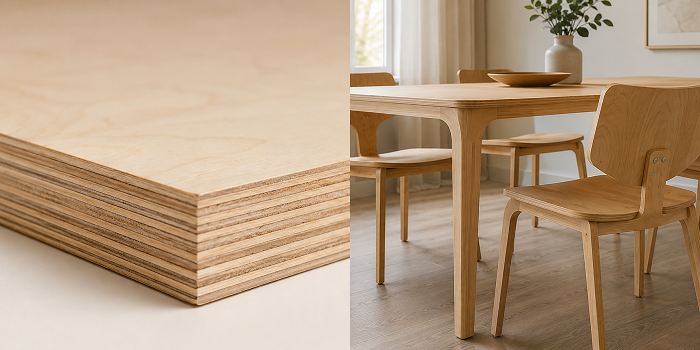
Plywood
Plywood is made by bonding multiple layers of wood veneer in alternating directions. It provides good structural stability and is commonly used for curved chair backs and shaped furniture components. However, the quality and performance of plywood can vary significantly depending on the manufacturing process and material grade.
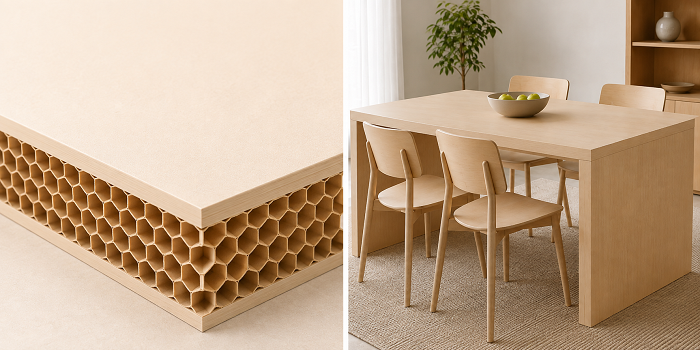
Honeycomb Board
Honeycomb board uses a lightweight internal structure to reduce overall weight while maintaining a certain level of flatness and rigidity. It is suitable for some large-sized furniture applications, but its edges and connection points often require additional reinforcement to ensure long-term stability.
Why Edge Banding Matters
Edge banding protects panel furniture by improving moisture resistance, edge durability, and long-term stability.
Function | Description |
|---|---|
Protect Core Material | Covers the internal structure exposed after cutting the board, preventing wood fibres or particles from being directly exposed. |
Reduce Moisture Exposure | Reduces the risk of moisture entering the board through edges, helping prevent swelling and deformation. |
Improve Edge Durability | Enhances the edge’s resistance to impact, friction, and daily wear during use. |
Enhance Appearance and Feel | Creates smoother furniture edges, reduces rough surfaces, and improves the overall look and tactile experience. |
Prevent Material Loss | Helps prevent wood particles and fibres from falling off due to impact or long-term use. |
Common Edge Banding Problems
Identify common edge banding issues to understand how they affect furniture appearance, durability, and long-term performance.
Problem | Possible Impact |
|---|---|
Edge Lifting | The edge banding separates from the board, affecting appearance and potentially causing further damage over time. |
Visible Glue Lines | Indicates poor edge banding workmanship or bonding quality, reducing the overall furniture finish. |
Uneven Corners | Can collect dust and increase the risk of damage caused by impacts during use. |
Gaps Between Edge Banding and Surface | Allow moisture and stains to enter the internal structure more easily. |
Chipped Corners After Moving | Insufficient edge protection may cause the board to chip or break when exposed to external impact. |
Swelling After Moisture Exposure | Moisture entering the internal material may lead to deformation, bubbling, or surface peeling. |
How to Maintain Edge Banding
Simple care tips to protect edge banding and extend furniture lifespan.
Maintenance Tips | Reason |
|---|---|
Avoid leaving water on joints or edges for a long time | Reduces the risk of moisture entering the board through the edges. |
Dry the surface promptly after cleaning | Minimises the long-term impact of moisture on edge banding and core materials. |
Avoid scratching edges with sharp objects | Helps prevent damage to the protective edge layer. |
Do not lift or move the table by holding only the edge banding | Prevents excessive force from loosening or separating the edge banding. |
Avoid continuous impact between corners and walls or hard objects | Reduces the risk of corner damage and edge banding deterioration. |
Furniture Surface Finishes Explained
Learn how veneer, melamine, PVC film, and decorative paper affect furniture appearance and feel.
Finish | Characteristics | Advantages | Limitations |
|---|---|---|---|
Natural Veneer | Thin sheets of natural wood applied to the surface of a board | Authentic grain patterns and a strong natural feel | Thin surface layer, deep scratches may be difficult to repair |
Melamine | Decorative paper combined with resin and pressed onto the board surface | Wide range of colours and patterns, easy to clean, resistant to daily wear | Edges and joints may be vulnerable to moisture |
PVC Film | Plastic film applied over the board surface | Can cover complex shapes and curved edges, easy to maintain | High temperatures and ageing of the adhesive layer may affect the surface |
Decorative Paper | Printed designs used to replicate wood grain patterns | Lower cost and a wide range of design options | Durability depends on the quality of the protective coating |
Types of Furniture Surface Finishes
Learn about the materials behind different furniture surfaces and their unique features.
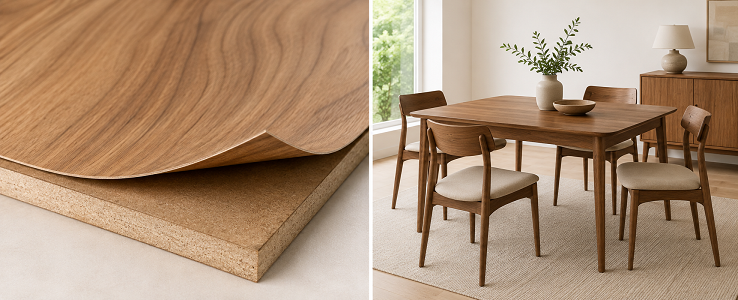
Natural VeneerNatural veneer is made by cutting natural wood into thin sheets and applying them to the surface of a board. It provides authentic wood grain and natural variations, creating a genuine wood appearance. However, as the surface layer is relatively thin, deep scratches may affect its appearance.
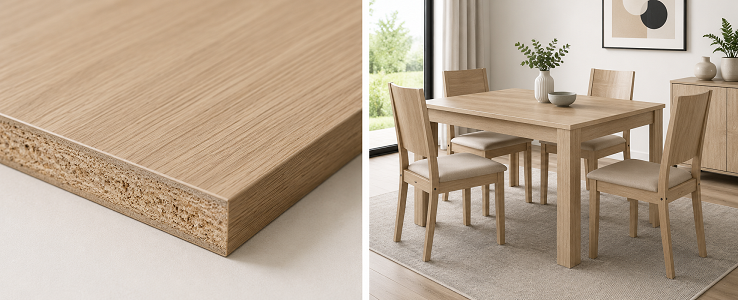
Melamine FinishMelamine finish offers a wide range of texture options, a smooth surface, and easy maintenance. It is commonly used for dining tables, cabinets, and office furniture due to its practicality and durability.
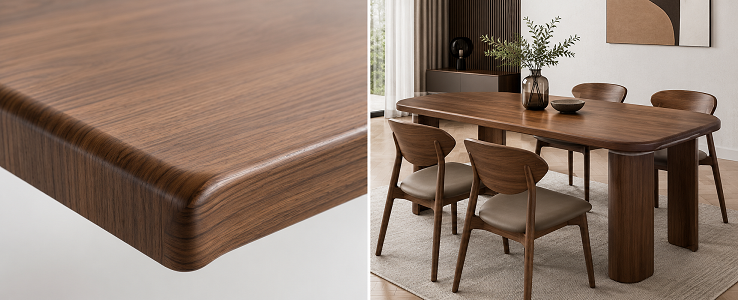
PVC FilmPVC film can be applied to curved surfaces and complex edges, offering a wide variety of colours and patterns. However, long-term use may be affected by high temperatures and the ageing of the adhesive layer.
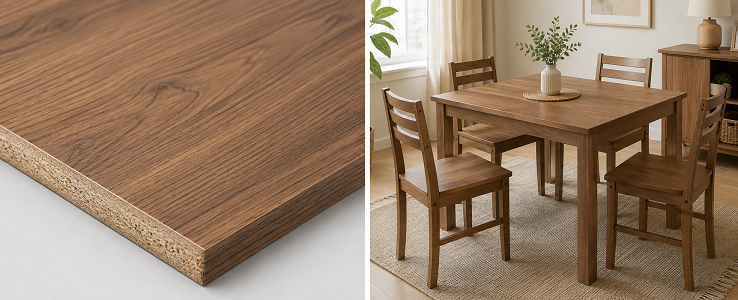
Decorative PaperDecorative paper uses printed designs to replicate the appearance of natural wood grain. It is a cost-effective surface option, but its scratch resistance and water resistance depend on the quality of the protective coating.
Special Dining Table Materials
Glass dining tables and marble-effect dining tables are also popular choices.
Material | Characteristics | What to Consider |
|---|---|---|
Tempered Glass | Lightweight visual appearance, easy to clean | Glass thickness, edge treatment, and fixing methods |
Marble Effect | Can be created using different base materials | Check the actual material rather than judging only by appearance |
Ceramic / Porcelain Tile | Good heat resistance and wear resistance | Edge impact resistance |

Dining Chair Upholstery Material Comparison
Compare common upholstery materials to understand their comfort, appearance, maintenance needs, and limitations.
Material | Advantages | Limitations |
|---|---|---|
Velvet | Soft texture, premium look, and a wide range of colour options | May show differences in fabric direction and leave visible marks from touch |
PU Leather | Easy to clean and resistant to liquid absorption | Long-term friction may cause peeling, and breathability is limited |
Fabric / Linen | Breathable, natural feel, and suitable for various interior styles | Absorbs liquids easily and can be more difficult to clean |
Rattan | Breathable, lightweight, and offers a natural style | Gaps can be harder to clean and require a more suitable environment |
Dining Chair Foam Explained
Discover how different foam properties influence comfort, support, and durability.
Factor | Quality Performance | Potential Issues |
|---|---|---|
Foam Density | Higher density provides a more stable structure and is less likely to deform quickly after long-term use | Low-density foam may develop permanent dents quickly, even if the cushion is thicker |
Resilience | Recovers shape quickly after sitting and maintains stable support | Poor resilience may cause faster foam fatigue and deformation |
Compression Firmness | Provides suitable support based on usage needs while maintaining comfort | Foam that is too soft may lack support, while foam that is too firm may reduce comfort |
Seat Support | A stable seat structure helps distribute pressure evenly | Insufficient support can accelerate foam fatigue and cause sagging |
Usage Frequency | Suitable for the intended usage environment and long-term seating needs | High-frequency use requires higher durability from the foam |
Metal Frame Quality Checklist
Key factors to assess frame strength, stability, and long-term durability.
Inspection Item | Quality Performance | Potential Issues |
|---|---|---|
Tube Thickness | Proper tube thickness provides stable support and reduces the risk of deformation | Tubes that are too thin may affect load-bearing capacity and long-term stability |
Welding Quality | Smooth and consistent welds without obvious burrs or cracks | Rough or uneven welds may weaken the frame structure |
Structural Symmetry | Matching dimensions and balanced frame structure | Uneven components may cause instability or affect appearance |
Structural Symmetry | Accurate mounting holes and well-matched connections ensure stable assembly | Misaligned holes may make installation difficult or cause looseness |
Connection Fit | Tight connections between frame components without visible gaps | Loose connections may lead to shaking over long-term use |
Surface Coating | Complete coating coverage with no peeling or exposed areas | Damaged coating may reduce protection against rust |
Tube End Treatment | Tube openings are sealed or properly finished with safe edges | Exposed tube ends may collect dust or affect appearance |
Rust Protection | No rust spots and complete surface protection | Rust marks may indicate damaged surface protection |
Find Your Ideal Dining Furniture


Frequently Asked Questions
How do I know if a dining table is suitable for everyday use?
A dining table suitable for everyday use should provide a balance between durability, stability, and easy maintenance. Besides the visible surface material, consumers should also consider the table structure, leg stability, edge protection, surface resistance, and whether the material fits their lifestyle. For frequently used dining areas, practical features such as easy cleaning and strong structural support are often more important than appearance alone.
Does a heavier dining table always mean better quality?
Not necessarily. The weight of a dining table depends on various factors, including material type, internal structure, thickness, and design. A lightweight table with a well-designed structure can still provide excellent stability, while a heavier table does not always guarantee better durability. Material quality and construction methods are more important than weight alone.
Why do two dining tables with similar appearances have different prices?
The price difference usually comes from differences in core materials, manufacturing processes, surface finishes, hardware, and structural design. Two dining tables may look similar from the outside but use completely different internal materials or production methods, which can significantly affect durability, stability, and long-term performance.
How can I maintain a dining table to extend its lifespan?
Proper maintenance depends on the material of the dining table. In general, avoid prolonged exposure to moisture, clean spills promptly, use suitable cleaning products, and protect surfaces from strong impacts or scratches. For panel furniture, keeping edges and joints dry is especially important to prevent moisture-related damage.
What factors affect dining chair comfort besides the seat cushion?
Dining chair comfort depends on multiple factors, including seat height, backrest design, seat depth, frame support, upholstery material, and overall ergonomic design. A comfortable dining chair should provide proper body support instead of relying only on soft cushioning.
What should I check before buying a dining table online?
Before purchasing a dining table online, consumers should check the product dimensions, material description, weight capacity, assembly requirements, surface finish, maintenance needs, and customer reviews. Understanding these details helps ensure the furniture matches the available space and intended usage.
Conclusion
When evaluating dining furniture materials, the key question is not simply whether it is “real wood.” More importantly, consumers should understand the internal core material, surface finish, structural support, and whether the materials are suitable for their actual usage environment.
A wood grain appearance does not always mean the furniture is made from solid wood. The durability of panel furniture depends on the surface finish and edge banding quality. The comfort of dining chairs is influenced by upholstery, foam, and support structure, while the reliability of metal frames depends on welding quality, connection methods, and surface treatment.
References
1. UK Government.
The Furniture and Furnishings (Fire) (Safety) Regulations 1988 (as amended).
UK Government legislation.
2. British Standards Institution (BSI). BS EN 12521:2015 Furniture — Strength, durability and safety — Requirements for domestic tables. British Standards Institution, London.
3. British Standards Institution (BSI). BS EN 16139:2013 Furniture — Strength, durability and safety — Requirements for non-domestic seating. British Standards Institution, London.
4. British Standards Institution (BSI). BS EN 1728:2012 Furniture — Strength, durability and safety — Test methods for seating. British Standards Institution, London.
5. British Standards Institution (BSI). BS EN 14322:2021 Wood-based panels — Melamine faced boards for interior uses — Definition, requirements and classification. British Standards Institution, London.
6. Forest Research. Wood Properties and Timber Characteristics. Forest Research, UK.
7. Timber Trade Federation (TTF). Timber and Timber Products: Technical Information and Industry Guidance. Timber Trade Federation, UK.
8. European Panel Federation (EPF). Wood-Based Panels Technical Information: MDF, Particleboard and Related Panel Products. European Panel Federation.
9. European Furniture Manufacturers Federation. Furniture Quality, Durability and Sustainability Guidelines. European Furniture Industry Association.
10. British Standards Institution (BSI). BS 4875 Furniture — Strength and Stability of Furniture — Requirements for Domestic and Contract Furniture. British Standards Institution, London.
Author Bio
Dr. Amelia Whitmore specializes in furniture materials, product construction, and household furniture evaluation. Her research interests include wood-based materials, upholstery systems, surface finishes, and the relationship between material selection and everyday furniture performance. Through her work, she aims to make complex furniture knowledge easier to understand and provide practical insights for consumers choosing durable and suitable furniture solutions.