

Last Updated: 07/08/2026
Abstract
Explore the evolution of outdoor umbrellas from simple sun shades to fully-featured systems. Understand pole types, tilting mechanisms, cantilever structures, rotating bases and LED lighting, and learn how design advances enhance comfort, versatility, and safety for gardens, terraces and balconies.By examining the relationship between canopy, frame, support and base, it reveals how modern parasol design has become more flexible, functional and responsive to the changing ways gardens, terraces and balconies are used.
Keywords
Outdoor umbrella, garden parasol, cantilever parasols, tilting parasols, double-sided parasols, parasol bases, LED garden parasol, parasol covers & accessories, outdoor shading system, umbrella stability, weather-resistant umbrella
Introduction
A modern outdoor parasol is much more than a canopy attached to a pole.
Behind its simple appearance is a carefully designed structure made up of supporting frames, folding mechanisms, adjustment systems and stabilising components. Every element has a specific purpose — from opening and closing the canopy, to changing its angle, supporting larger coverage areas and improving overall usability.
As parasols have evolved, their structures have become increasingly sophisticated. Centre-pole designs introduced the basic support system, while crank mechanisms, tilt joints, cantilever arms, rotating bases and integrated lighting have expanded what a parasol can achieve.
This guide explores the key structural elements behind modern outdoor parasols, explaining how different components work together and how parasol designs have developed from a simple shade solution into a complete outdoor structure.
Behind its simple appearance is a carefully designed structure made up of supporting frames, folding mechanisms, adjustment systems and stabilising components. Every element has a specific purpose — from opening and closing the canopy, to changing its angle, supporting larger coverage areas and improving overall usability.
As parasols have evolved, their structures have become increasingly sophisticated. Centre-pole designs introduced the basic support system, while crank mechanisms, tilt joints, cantilever arms, rotating bases and integrated lighting have expanded what a parasol can achieve.
This guide explores the key structural elements behind modern outdoor parasols, explaining how different components work together and how parasol designs have developed from a simple shade solution into a complete outdoor structure.
The first shade structure
A single pole supporting a patch of shade


The earliest parasols used the simplest structural principle: a central pole supporting a canopy. The pole held the canopy above the user, creating a small area of shade.
Advantages
• Simple to manufacture
• Easy to use
• Naturally stable with centred support
Limitations
• Pole occupies the centre space
• Limited flexibility as sunlight moves
• Designed for personal shade, not for furinshing a space
Advantages
• Simple to manufacture
• Easy to use
• Naturally stable with centred support
Limitations
• Pole occupies the centre space
• Limited flexibility as sunlight moves
• Designed for personal shade, not for furinshing a space
The birth of folding ribs
How parasols became openable and foldable
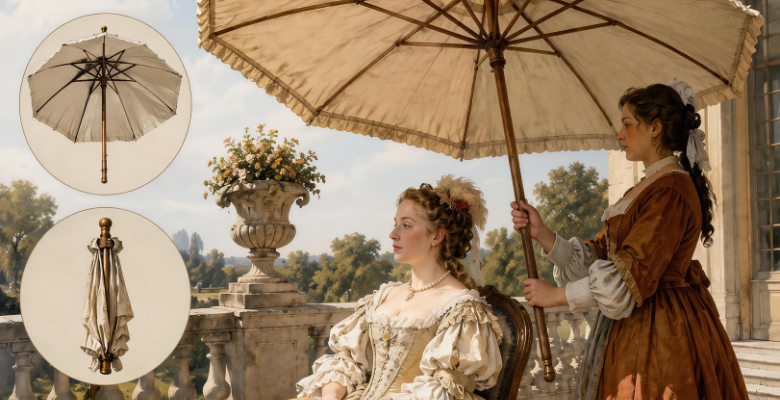
Folding ribs changed the parasol from a fixed canopy into a movable structure.
They allow the canopy to expand outwards when opening and fold neatly when closing.
• Quick opening
Shade when you need it
• Compact folding
Easy to store
• Tension and stability
Multiple support points keep the canopy taut
They allow the canopy to expand outwards when opening and fold neatly when closing.
• Quick opening
Shade when you need it
• Compact folding
Easy to store
• Tension and stability
Multiple support points keep the canopy taut
The centre-pole structure
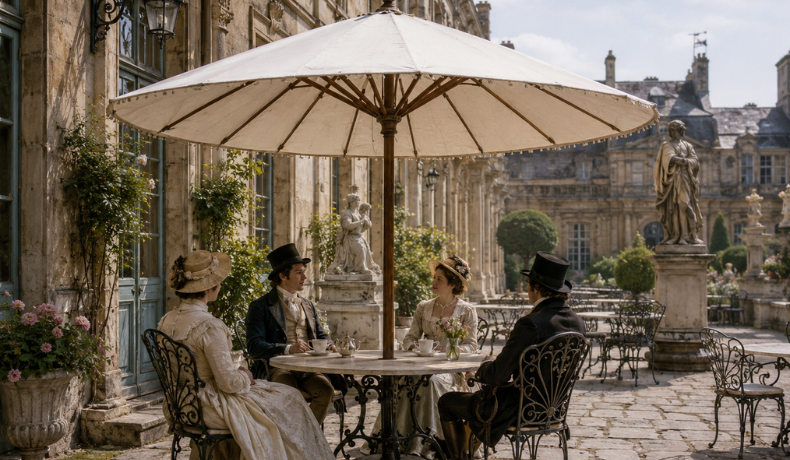
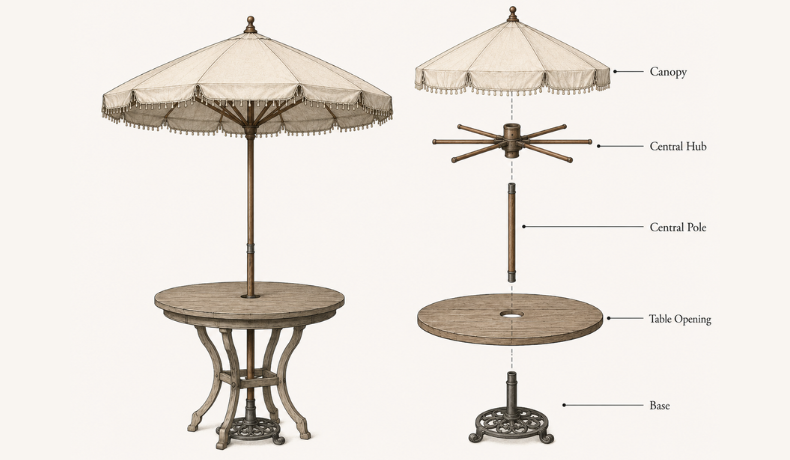
The foundation of modern garden parasols
As parasols became widely used in gardens, patios and outdoor dining areas, the centre-pole structure became the classic form of modern parasol design.
The structure is built around a simple principle: a central pole supports the canopy from underneath, while the ribs extend evenly around the central hub to create a balanced shade system.
Key structural elements include:
- Central pole – the main vertical support
- Central hub – the connection point for the ribs
- Rib system – maintains the canopy shape
- Base connection – transfers the load to the ground
With the support positioned directly beneath the canopy, the load path is simple and stable:
Canopy → Hub → Pole → Base
Its main limitation is also caused by its central design. The pole remains in the middle of the shaded area, reducing flexibility when arranging outdoor furniture.
The centre-pole structure remains one of the most important foundations of modern parasol engineering.
The centre-pole parasol is the clearest expression of the basic parasol form.
Its main pole is positioned beneath the geometric centre of the canopy, and the frame opens approximately symmetrically around that axis.
The structure is built around a simple principle: a central pole supports the canopy from underneath, while the ribs extend evenly around the central hub to create a balanced shade system.
Key structural elements include:
- Central pole – the main vertical support
- Central hub – the connection point for the ribs
- Rib system – maintains the canopy shape
- Base connection – transfers the load to the ground
With the support positioned directly beneath the canopy, the load path is simple and stable:
Canopy → Hub → Pole → Base
Its main limitation is also caused by its central design. The pole remains in the middle of the shaded area, reducing flexibility when arranging outdoor furniture.
The centre-pole structure remains one of the most important foundations of modern parasol engineering.
The centre-pole parasol is the clearest expression of the basic parasol form.
Its main pole is positioned beneath the geometric centre of the canopy, and the frame opens approximately symmetrically around that axis.
The evolution of opening systems
From push-up mechanisms to crank operation
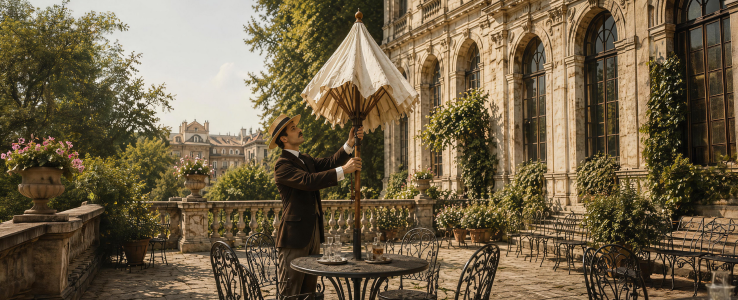
Direct manual openingEarly parasols used a simple push-up system, where the user manually moved the runner upwards to expand the rib structure.
This mechanism relies directly on physical force and works well for smaller parasols with lighter canopy frames. However, as parasols became larger, opening the structure required more effort and greater control.
This mechanism relies directly on physical force and works well for smaller parasols with lighter canopy frames. However, as parasols became larger, opening the structure required more effort and greater control.
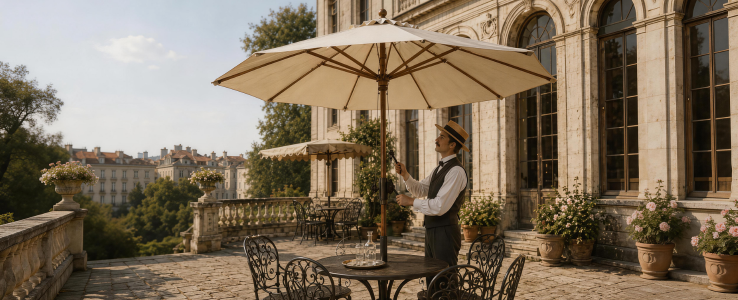
Mechanical opening systemThe crank mechanism introduced a more efficient way to operate larger parasols.
By turning the handle, an internal cord and pulley system gradually lifts the runner and extends the ribs. This reduces the force required from the user while providing smoother and more controlled canopy movement.
By turning the handle, an internal cord and pulley system gradually lifts the runner and extends the ribs. This reduces the force required from the user while providing smoother and more controlled canopy movement.
The tilting structure
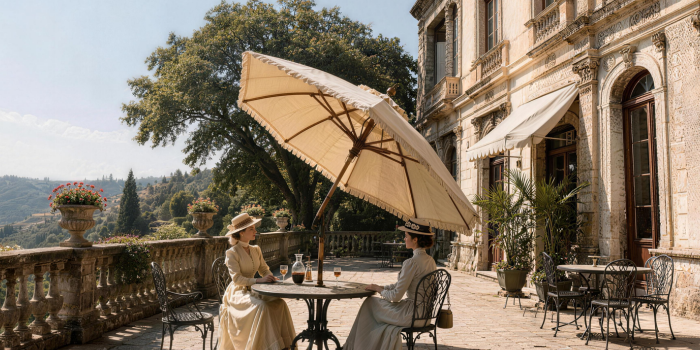
How parasols began following the sun
Sunlight changes direction throughout the day, and fixed canopies cannot always block low-angle rays in the morning or late afternoon. Tilting mechanisms allow the canopy angle to be adjusted, helping shade follow the sun and creating a more flexible outdoor structure.
The tilt joint, usually positioned near the upper pole or rib connection, transforms the parasol from a fixed shade solution into an adjustable system.
The tilt joint, usually positioned near the upper pole or rib connection, transforms the parasol from a fixed shade solution into an adjustable system.
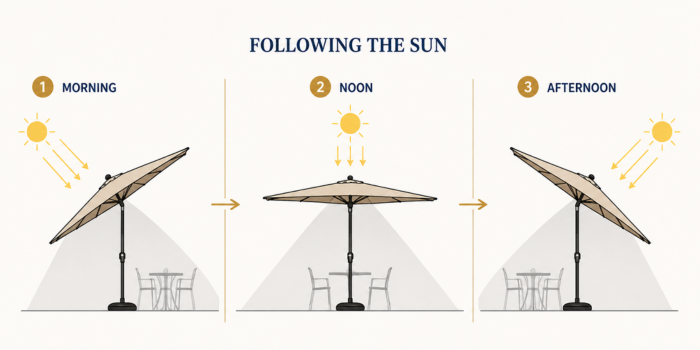
Following the sun
The sun changes position throughout the day, causing shade direction to shift from morning to afternoon. A tilting parasol allows the canopy angle to be adjusted, helping maintain more consistent shade as sunlight moves.
By changing the canopy position around the tilt joint, the parasol adapts to different sun angles and provides a more flexible outdoor shading solution.
By changing the canopy position around the tilt joint, the parasol adapts to different sun angles and provides a more flexible outdoor shading solution.
From central support to offset support
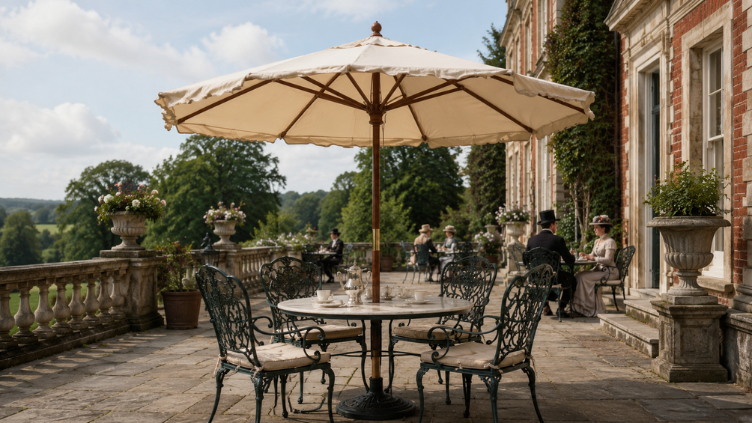

Centre pole

Simple structure, balanced support and fewer mechanical components.

The central pole reduces the usable space beneath the canopy.

Pro Tip
A centre-pole parasol supports the canopy from the middle, creatinga direct and balanced load path.
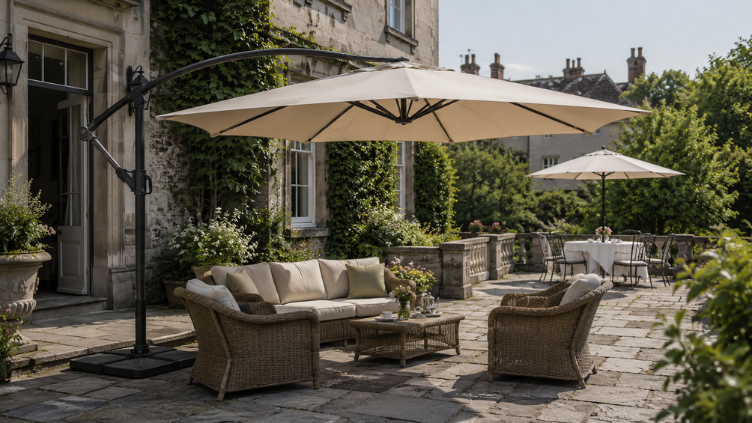

Cantilever
Clear space below the canopy and greater flexibility in canopy positioning.
A more complex frame, increased offset loading and greater dependence on the base structure.
Pro Tip
A cantilever parasol moves the support structure to the side, freeingthe area beneath the canopy.
The rotating structure
From fixed shade to flexible coverage
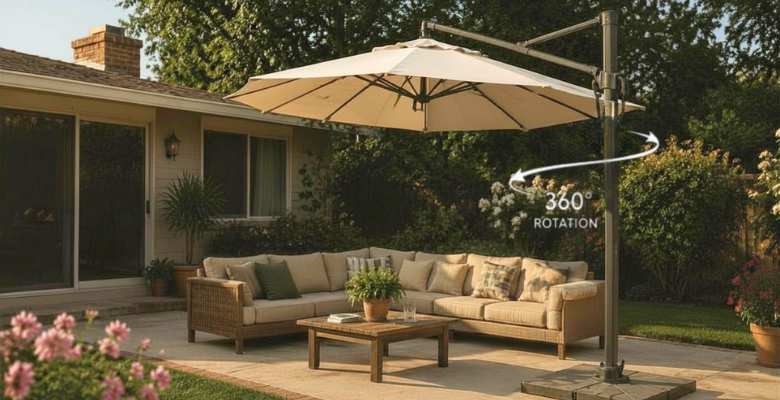
Rotating shade coverage
A rotating structure allows the parasol to turn around its base, adjusting the shade direction without moving the heavy support system.
By following the sun throughout the day, one parasol can cover different areas, from dining spaces to outdoor lounges. Combined with tilt and crank mechanisms, rotation creates a more flexible and adaptable shading solution.
By following the sun throughout the day, one parasol can cover different areas, from dining spaces to outdoor lounges. Combined with tilt and crank mechanisms, rotation creates a more flexible and adaptable shading solution.
Base structure upgrade
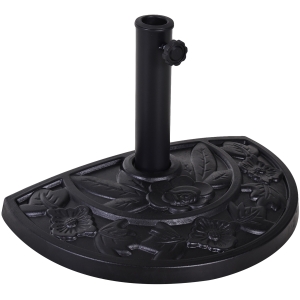
Common base structures
Base structure | How it works | Structural characteristics | Common frame connection |
|---|---|---|---|
Standard weighted base | Uses a solid round or square body to hold the pole upright and add weight at ground level. | Simple, compact and based on centred downward loading. | Vertical sleeve with tightening knob |
Concrete base | Uses dense concrete to provide permanent ballast within a moulded or metal shell. | High mass in a relatively compact form; generally difficult to move. | Pole sleeve or adaptor rings |
Granite base | Uses a solid stone slab to combine ballast with a rigid, low-profile platform. | Dense, durable and visually more refined than basic moulded bases. | Metal sleeve fixed through the stone |
Water- or sand-fillable base | A hollow shell is filled after positioning to increase its total mass. | Lighter when empty; final stability depends on fill volume and material. | Integrated sleeve or cantilever base interface |
Cross base with ballast blocks | A metal cross frame spreads the load across four arms, with separate weights placed above them. | Common in cantilever structures; the cross frame distributes ballast but may not provide enough weight by itself. | Bolted connection to the vertical mast |
Wheeled heavy-duty base | Combines a weighted platform with wheels and a locking or braking system. | Supports repositioning while retaining substantial ballast. | Mast socket or rotating lower plate |
Commercial fixed base | Uses a reinforced metal platform or permanent weighted assembly for frequent use. | Rigid, heavy and designed around repeated operation and larger frames. | Bolted mast connection |
Ground-bolted fixing | Transfers parasol loads directly into a concrete slab or structural ground fixing. | Removes the need for movable ballast and creates a fixed load path. | Anchor bolts and mounting plate |
Recommended bases
Half and wall-mounted structures
Adapting shade for smaller outdoor spaces
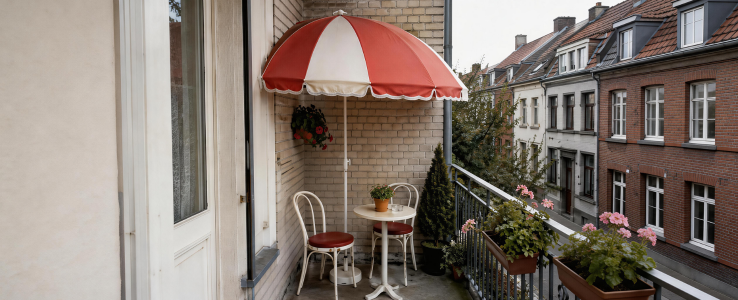
Half parasol structuresAs outdoor living moved into balconies, compact patios and narrow urban corners, parasol design had to become more space-efficient. The half parasol adapted the traditional canopy into a semicircular form, allowing it to sit neatly against a wall while preserving useful shade with a smaller footprint.
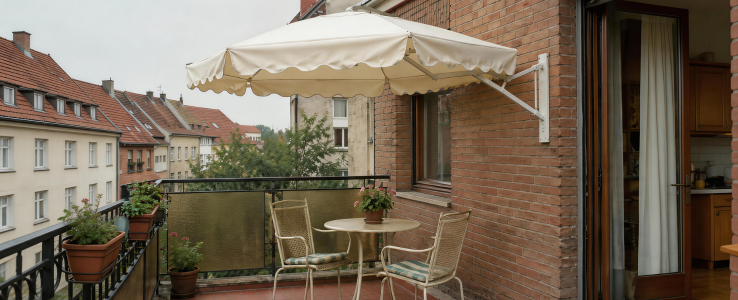
Wall-mounted parasol structuresWall-mounted parasols developed as outdoor spaces became more compact. By transferring the support point from the ground to the wall, they remove the need for a floor-standing pole and base, creating a clearer and more efficient shaded area.
Canopy geometry, vents, materials and connections
From basic shade to ventilation and outdoor performance
modern parasol canopies do more than block sunlight. they are designed to support airflow, resist light moisture and reduce ultraviolet exposure.
vented and double-top structures allow warm air to escape and help reduce pressure beneath the canopy in breezy conditions. reinforced seams, rib pockets and outdoor fabrics also help the canopy maintain its shape and tension.
modern parasol canopies do more than block sunlight. they are designed to support airflow, resist light moisture and reduce ultraviolet exposure.
vented and double-top structures allow warm air to escape and help reduce pressure beneath the canopy in breezy conditions. reinforced seams, rib pockets and outdoor fabrics also help the canopy maintain its shape and tension.
Key developments
- vented or double-top canopy
- water-resistant fabric
- uv-resistant treatment
- reinforced seams and rib pockets
- improved airflow and structural stability
- water-resistant fabric
- uv-resistant treatment
- reinforced seams and rib pockets
- improved airflow and structural stability
Lighting structure added
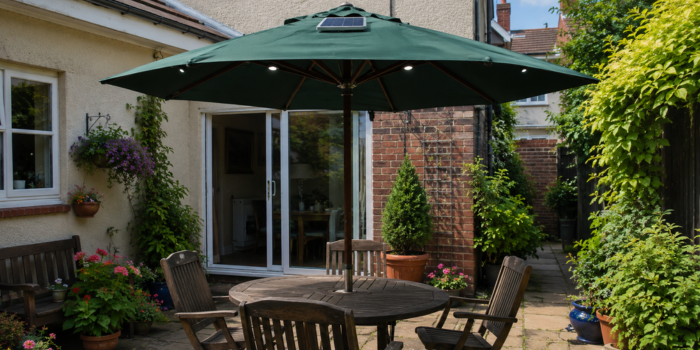
Extending parasol use beyond daylight
Integrated lighting systems extend the function of the parasol beyond daytime use. LED lights are built into the rib structure, allowing the canopy to provide both shade and gentle evening illumination.
Key structural elements
- Rib-mounted LED lights
- Integrated wiring
- Control switch
- Lighting built into the canopy frame
Key structural elements
- Rib-mounted LED lights
- Integrated wiring
- Control switch
- Lighting built into the canopy frame
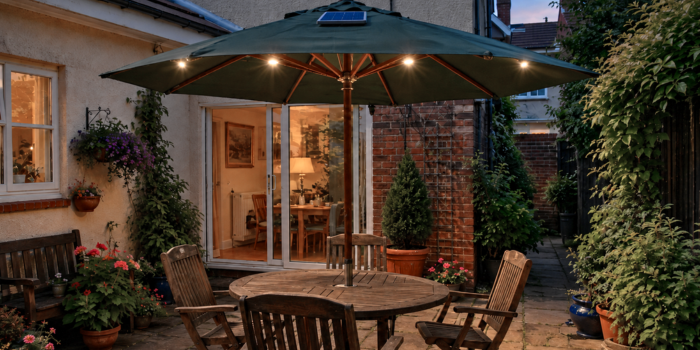
From daytime shade to evening illumination
Integrated LED lighting allows the parasol to remain useful after sunset. By placing the lighting within the rib structure, the canopy provides both shade by day and gentle illumination in the evening.
Modern parasols
Support structure
The support structure defines how the parasol carries its canopy, from traditional centre-pole designs to flexible cantilever systems.
... See more
Opening system
Crank mechanisms and manual lifts control how the canopy opens and closes, improving convenience and reducing effort.
... See more
Adjustment system
Tilt and rotation functions allow the canopy to follow changing sunlight and adjust shade direction throughout the day.
... See more
Stability system
Weighted bases and ballast systems provide the stability needed to support larger canopies and offset structures.
... See more
Canopy system
Modern canopies combine UV resistance, water-resistant fabrics and ventilation designs for improved outdoor performance.
... See more
Additional features
LED lighting, protective covers, replacement canopies and accessories enhance usability and extend product life.
... See more
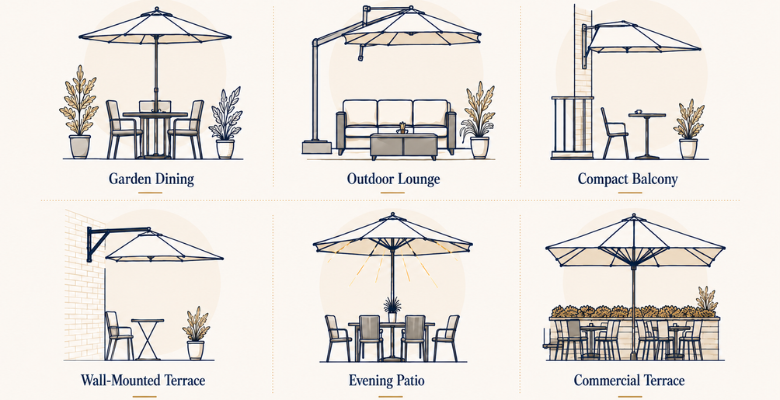
Different structures for different outdoor settings
Modern parasols are no longer limited to a canopy, pole and base. They bring together several structural systems, including support frames, opening mechanisms, tilt and rotation functions, weighted bases, ventilated canopies and integrated lighting.
Each part performs a specific role, but the real development lies in how these elements work together. The support structure carries the canopy, the opening system controls movement, the base manages stability, and the canopy and lighting systems extend comfort and usability.
This evolution has transformed the parasol from a single shade product into a coordinated outdoor system designed around structure, function and space.
Each part performs a specific role, but the real development lies in how these elements work together. The support structure carries the canopy, the opening system controls movement, the base manages stability, and the canopy and lighting systems extend comfort and usability.
This evolution has transformed the parasol from a single shade product into a coordinated outdoor system designed around structure, function and space.
Conclusion
The evolution of the outdoor parasol has not been driven by complexity for its own sake, but by the changing ways in which gardens, patios and balconies are used. What began as a single pole supporting a small area of shade gradually developed into folding, tilting, cantilevered and rotating structures, with ventilated canopies, weighted bases and integrated LED lighting.
Each structural improvement responded to a practical need: easier operation, wider coverage, greater flexibility, better use of compact spaces and longer use beyond daylight hours. Modern parasols are therefore no longer simple shade products. They are coordinated outdoor systems designed to make exterior spaces more comfortable, adaptable and usable throughout the day.
Each structural improvement responded to a practical need: easier operation, wider coverage, greater flexibility, better use of compact spaces and longer use beyond daylight hours. Modern parasols are therefore no longer simple shade products. They are coordinated outdoor systems designed to make exterior spaces more comfortable, adaptable and usable throughout the day.
References
1. Royal Horticultural Society. “Garden Shade Structures: Design and Safety.” RHS Publications, 2023.
2. British Standards Institution. BS EN 581-1:2020 – Outdoor Furniture – Seating and Tables – General Safety Requirements.
3. Garden Centre Association UK. “Choosing the Right Patio Umbrella.” GCA Guidance, 2022.
4. Outdoor Furniture Review UK. “Cantilever vs Central Pole Umbrellas: Performance and Safety.” OFR, 2023.
5. Home & Garden Expert UK. “Patio Umbrella Materials and Longevity.” HGE Journal, 2022.
6. The Telegraph Gardening Section. “Maximising Shade and Comfort on UK Terraces.” 2023.
7. Furniture Industry Research Association (FIRA) UK. “Outdoor Umbrella Stability Testing.” FIRA Technical Report, 2021.
8. BBC Gardeners’ World. “How to Position and Secure Garden Parasols Safely.” 2022.
2. British Standards Institution. BS EN 581-1:2020 – Outdoor Furniture – Seating and Tables – General Safety Requirements.
3. Garden Centre Association UK. “Choosing the Right Patio Umbrella.” GCA Guidance, 2022.
4. Outdoor Furniture Review UK. “Cantilever vs Central Pole Umbrellas: Performance and Safety.” OFR, 2023.
5. Home & Garden Expert UK. “Patio Umbrella Materials and Longevity.” HGE Journal, 2022.
6. The Telegraph Gardening Section. “Maximising Shade and Comfort on UK Terraces.” 2023.
7. Furniture Industry Research Association (FIRA) UK. “Outdoor Umbrella Stability Testing.” FIRA Technical Report, 2021.
8. BBC Gardeners’ World. “How to Position and Secure Garden Parasols Safely.” 2022.
Richard Davies
An expert in outdoor furniture standards and testing, Mr. Davies has published multiple studies on wind resistance, structural integrity and modular umbrella designs, ensuring safe and durable products for the UK and European markets.