

Last Updated: 27/04/2026
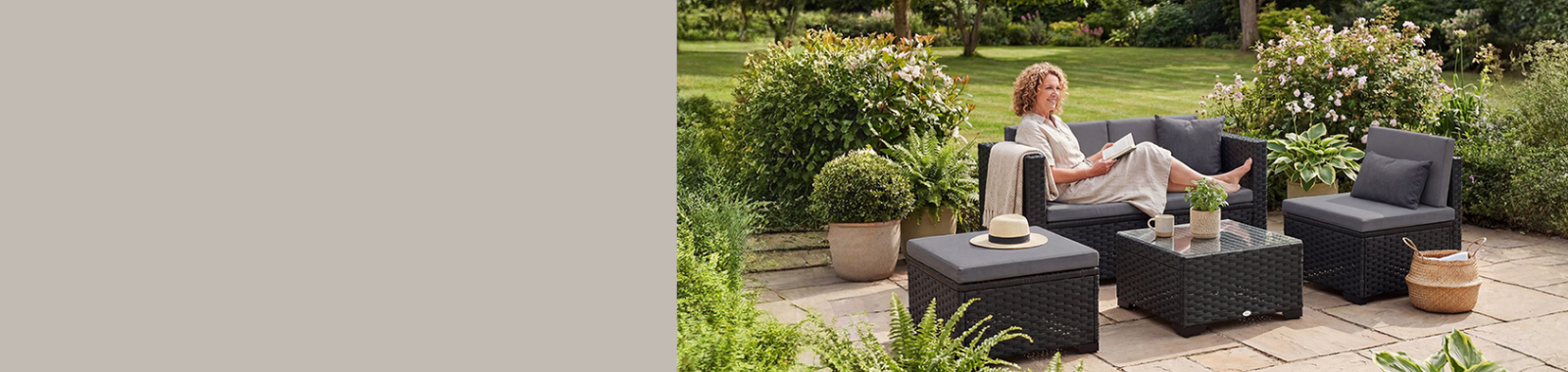
Have you ever regretted buying the wrong rattan sofa?
We’ve created this comprehensive rattan sofa buying guide to help you understand the selection criteria and usage requirements, avoid common mistakes, and make the most informed purchase decision.
Here, we break down:
Whether it’s a small balcony, a medium patio, or a large garden, this guide offers professional recommendations for selecting the perfect rattan sofa to suit your needs.
Here, we break down:
- Size & Space Fit for Rattan Sofas: It’s not just about fitting it in — it’s about ensuring the sofa blends perfectly into your outdoor space, enhancing comfort and aesthetics.
- Comfort & Support: Choosing the right seat depth and cushion thickness to elevate your seating experience, eliminating doubts about "too firm or too soft".
- Rattan & Outdoor Material Knowledge: Understand the difference between PE rattan and traditional rattan, and how to pick a sofa that’s UV-resistant, weatherproof, and durable.
- Build & Stability: How to evaluate the frame quality and ensure long-term stability and safety of your rattan sofa.
- Quick Self-Assessment Tool: Answer a few simple questions to quickly determine which type of rattan sofa is best for your needs.
Whether it’s a small balcony, a medium patio, or a large garden, this guide offers professional recommendations for selecting the perfect rattan sofa to suit your needs.
Space & Dimensions
Not Just Fit, But Functionality
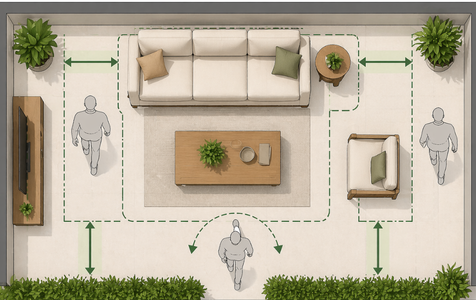
Functional Clearance
In outdoor layout planning, furniture size must be considered together with functional clearance.
A minimum of 50–60 cm walking space is recommended between the sofa and surrounding objects.
This is based on ergonomic movement standards, ensuring comfortable walking and turning
A minimum of 50–60 cm walking space is recommended between the sofa and surrounding objects.
This is based on ergonomic movement standards, ensuring comfortable walking and turning
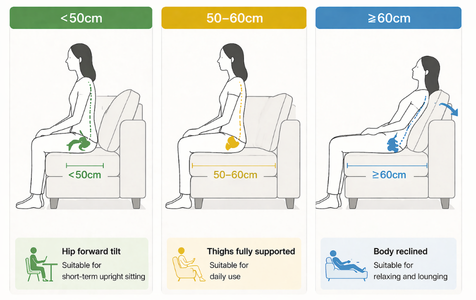
Seat Depth & Posture
Seat depth directly influences posture and load distribution:
- <50 cm → upright seating
- 50–60 cm → balanced daily comfort
- 60 cm → reclined lounging
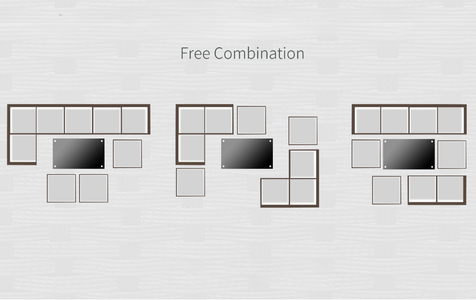
Modularity
Modular sofas use independent units to adapt to different layouts,
making them more space-efficient, especially in compact areas.
making them more space-efficient, especially in compact areas.
Comfort = Material Performance + Structural Support

Cushion Thickness & Compression
Comfort depends not only on thickness but also on compression behavior.
- <8 cm → insufficient buffering after compression
- 8–12 cm → maintains cushioning layer
The key factor is compression deformation rate.
... See more
- <8 cm → insufficient buffering after compression
- 8–12 cm → maintains cushioning layer
The key factor is compression deformation rate.
... See more

Foam Density
High-density foam (≥25kg/m³) offers better support and durability,
while low-density foam tends to deform over time.
... See more
while low-density foam tends to deform over time.
... See more

Backrest Ergonomics
Backrest angles typically range between 95°–110°:
Near 90° → upright
posture 100° → relaxed posture
This directly affects spinal load distribution.
... See more
Near 90° → upright
posture 100° → relaxed posture
This directly affects spinal load distribution.
... See more
Outdoor Performance Starts with Materials
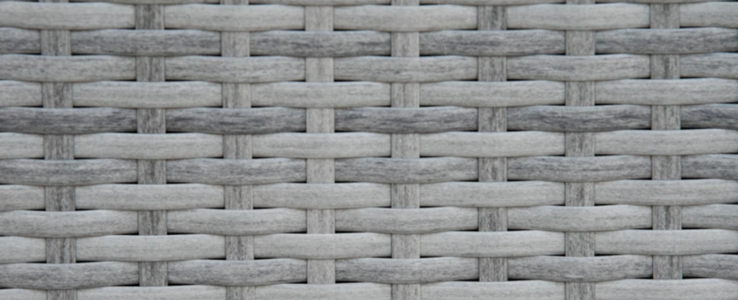

Rattan Structure: Weather-Resistant, Not Indestructible

Outdoor rattan sofas are typically made of PE rattan (high-density polyethylene), which offers:

Non-absorbent surface
UV resistance
High flexibility without cracking
Rattan itself is not load-bearing. Structural support comes from the internal metal frame (steel or aluminum).
Protects the frame
Distributes surface pressure

Usage & Lifespan
PE rattan performs well outdoors, but long-term exposure still affects durability:
- Strong UV → fading and brittleness
- Continuous rain → affects joints and frame
👉 Recommended:
- Use protective covers
- Avoid constant exposure year-round
- Strong UV → fading and brittleness
- Continuous rain → affects joints and frame
👉 Recommended:
- Use protective covers
- Avoid constant exposure year-round


Water Resistance vs Waterproof
Outdoor cushions typically consist of:
- Outer fabric: water-resistant coating
- Inner filling: foam (absorbent)
- Outer fabric: water-resistant coating
- Inner filling: foam (absorbent)
This means:
The surface resists splashes, but water can still penetrate over time.
The surface resists splashes, but water can still penetrate over time.
A common misunderstanding:
- Water-resistant
→ delays water penetration
- Waterproof
→ completely blocks water
- Water-resistant
→ delays water penetration
- Waterproof
→ completely blocks water
Most outdoor cushions are water-resistant, not waterproof.
Correct Usage
Proper usage is essential:
- Store cushions before rain
- Use protective covers
- Dry after exposure
- Store cushions before rain
- Use protective covers
- Dry after exposure
Structural Stability Determines Long-Term Performance
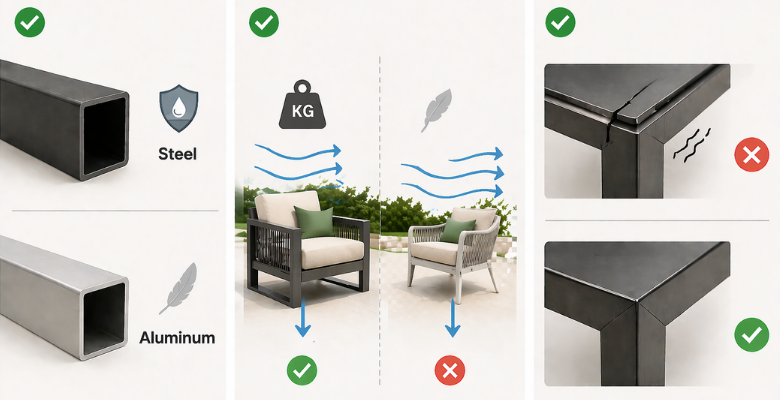

✔ Frame Materials
- Steel → strong, requires anti-rust coating
- Aluminum → lightweight, corrosion-resistant
✔ Weight & Stability
Heavier structures improve wind resistance and stability,but reduce portability.
✔ Joint Precision
Joint precision affects stability:
- Loose joints → wobbling
- Tight joints → solid structure
Find the Right Outdoor Sofa for Your Space
What is your space size?
- Small balcony (≤5 m²)
- Medium-sized terrace (5–15 m²)
- Large garden (≥15 m²)
... See moreHow often will you use it?
- Occasional use (at weekends/when the weather is fine)
- Regular use (for everyday leisure)
- Extended use (for relaxation/reading/socialising)
What is your weather condition?
- Mostly sunny with little rain
- Distinct seasonal changes
- Frequent rain / humid
... See more
- Distinct seasonal changes
- Frequent rain / humid
... See more
Do you need to move it often?
- Not required (fixed position)
- Occasional movement
- Frequent rearrangement
... See more
- Occasional movement
- Frequent rearrangement
... See more