

Last Updated: 07/08/2026
Abstract
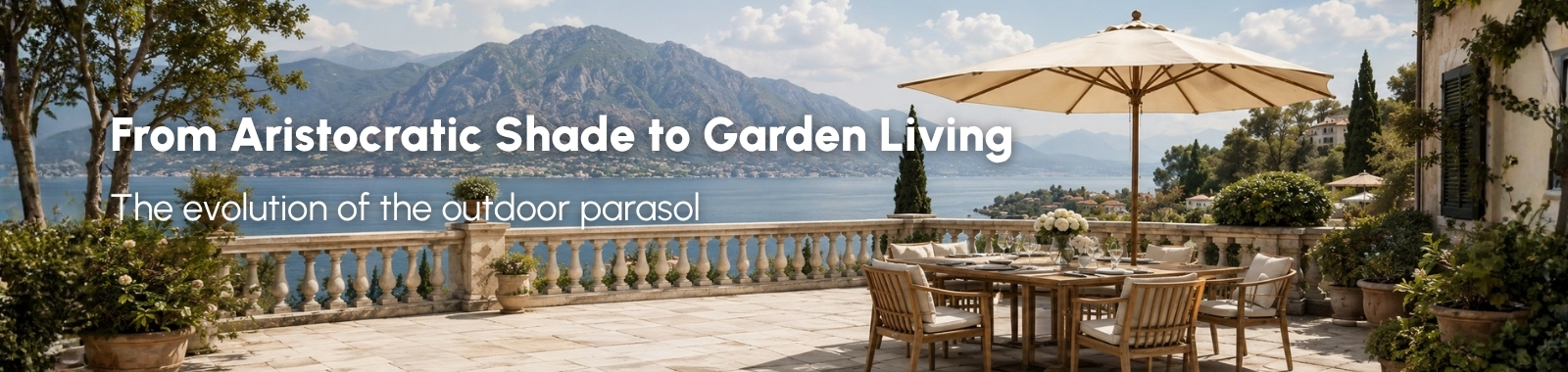
Today, when we think of outdoor parasols in Europe, we often picture a large canopy beside a garden dining table, a cantilever parasol shading a terrace sofa, or a space-saving half parasol tucked into the corner of a balcony. Outdoor parasols have become a familiar feature of European gardens, balconies, terraces and alfresco dining spaces.
Yet the parasol did not begin as a piece of outdoor furniture. Over time, it evolved from a symbol of status and privilege into a fashionable personal accessory, and eventually into a practical feature of modern garden living.
Its development also reflects a broader change in the European approach to outdoor life: from simply avoiding the sun to creating comfortable spaces in which to enjoy it.
Yet the parasol did not begin as a piece of outdoor furniture. Over time, it evolved from a symbol of status and privilege into a fashionable personal accessory, and eventually into a practical feature of modern garden living.
Its development also reflects a broader change in the European approach to outdoor life: from simply avoiding the sun to creating comfortable spaces in which to enjoy it.
Keywords
Evolution of the parasol; European parasol history; History of garden parasols; Outdoor parasol development; History of patio umbrellas; Traditional European parasols; Modern outdoor parasols; Cantilever parasol history; Balcony parasols; Half parasols; Centre pole parasols; Solar LED parasols; Parasol design evolution; Outdoor shade history; European outdoor living
More Than Just Shade
The story of the parasol reflects changing lifestyles across Europe. Its meaning shifted from ceremonial prestige, to fashionable personal accessory, and eventually to a practical comfort feature for everyday outdoor spaces

Ancient Civilisations
Shade as a Symbol of Power
... See more

17th–18th Century
The Parasol Enters European Fashion
... See more

19th Century
An Icon of Elegant Outdoor Leisure
... See more

20th Century
From Personal Accessory to Patio Furniture
... See more

21st Century
A Modern Outdoor Comfort System
... See more
From Status Symbol to Outdoor Furniture

Early Parasols: Symbols of Power, Status and Shade
The history of the parasol reaches far back into the ancient world. Parasol-like shade structures were used in ancient Egypt, Persia, Greece and Rome. At the time, they were not everyday household objects. They were more commonly associated with nobles, rulers, religious ceremonies and the lives of the upper classes.
In ancient societies, access to shade carried a certain social meaning. Ordinary people often worked under the sun, while rulers and elites could remain protected beneath a canopy. The parasol was therefore more than a practical shade tool; it was also a visible symbol of authority and social status.
Parasols from this period were often relatively large and used in a fixed or ceremonial way. They were frequently held by servants or attendants rather than carried by the person being shaded.
Their main value was not portability, but the prestige of being sheltered from the sun.
The 17th and 18th Centuries: The Parasol Returns to European Fashion
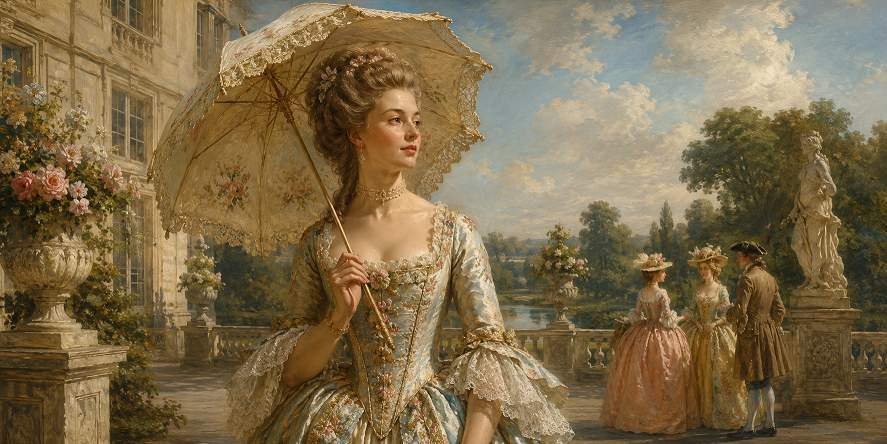
During the 17th and 18th centuries, growing trade between Europe, Asia and the Middle East introduced European society to new objects, materials and decorative styles. The parasol was among the items that returned to prominence during this period.
In France and Britain, parasols gradually became fashionable accessories for aristocratic women and members of the urban upper classes. They were no longer viewed only as practical tools for protection from the sun. Instead, they were coordinated with dresses, hats, gloves and fans as part of a complete fashionable appearance.
Parasols of this period became lighter, more portable and increasingly decorative. Canopies might feature silk, lace, embroidery or fringed details, while handles could be made from wood, ivory or metal.
Although they still provided shade, their main role was often to communicate elegance, status and refined taste.
In other words, the 18th-century European parasol was first a fashion accessory and only second a shade product.
The 19th Century: An Elegant Symbol of Garden, Carriage and Seaside Leisure
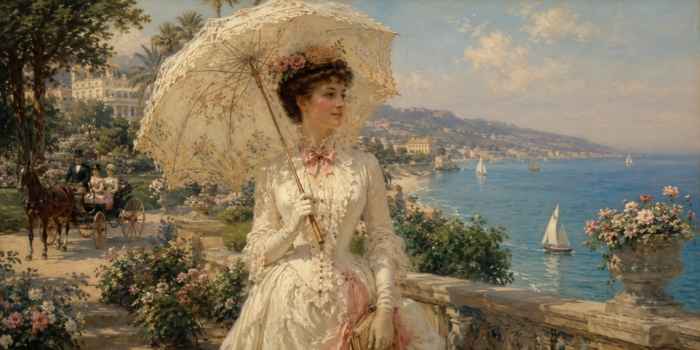
By the 19th century, parasols had become more common in the lives of European women. During the Victorian era and the French Belle Époque in particular, they frequently appeared during garden walks, carriage journeys, visits to city parks and seaside holidays.
At this stage, the parasol became closely connected with lifestyle and leisure. It formed part of the outdoor routines of Europe’s middle and upper classes. Women often carried finely decorated parasols while walking in gardens, travelling in open carriages or relaxing at coastal resorts.
The parasol offered protection from strong sunlight while also helping the wearer maintain a composed and elegant appearance.
It also became a familiar visual element in 19th-century European painting. Parasol scenes often included lawns, gardens, coastlines, long dresses, hats and soft afternoon sunlight, creating an image of outdoor life that felt relaxed, graceful and refined.
However, the parasol was still primarily a personal, handheld object. It had not yet fully developed into the garden, patio or terrace parasol that we recognise today.
The 20th Century: From Personal Accessory to Outdoor Furniture
The form of the modern outdoor parasol began to emerge more clearly during the 20th century.
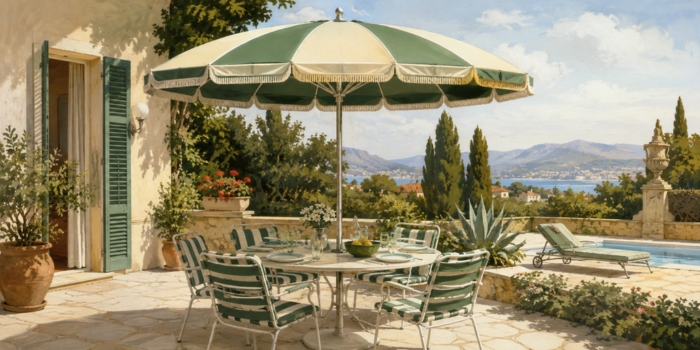
As European cities expanded, housing styles changed and gardens, balconies and terraces became more closely integrated into everyday life, the way parasols were used also changed significantly. Rather than being held by hand, they began to be fixed in place beside garden furniture, on terraces, near dining tables, beside swimming pools and in commercial outdoor spaces.
This marked an important transition: the parasol changed from a personal accessory into a product designed for the space itself.
Industrial manufacturing also transformed its materials and construction. Traditional silk, lace and decorative wooden handles were gradually replaced by aluminium, steel, polyester fabric, water-resistant coatings and UV-protective materials better suited to long-term outdoor use.
Modern outdoor parasols therefore needed to address much more than appearance. They also had to answer practical questions such as:
- Is the structure stable?
- Can it withstand wind?
- Does the canopy provide effective sun protection?
- Can it handle light rain?
- Is it easy to open and close?
- Will it work with different types of outdoor furniture?
- Is it easy to store and maintain?
It was during this period that parasols became closely associated with garden dining tables, outdoor sofas, sun loungers, barbecue areas and poolside seating.
New Forms for Modern Outdoor Spaces

The Rise of the Cantilever Parasol: A More Flexible Use of Outdoor Space

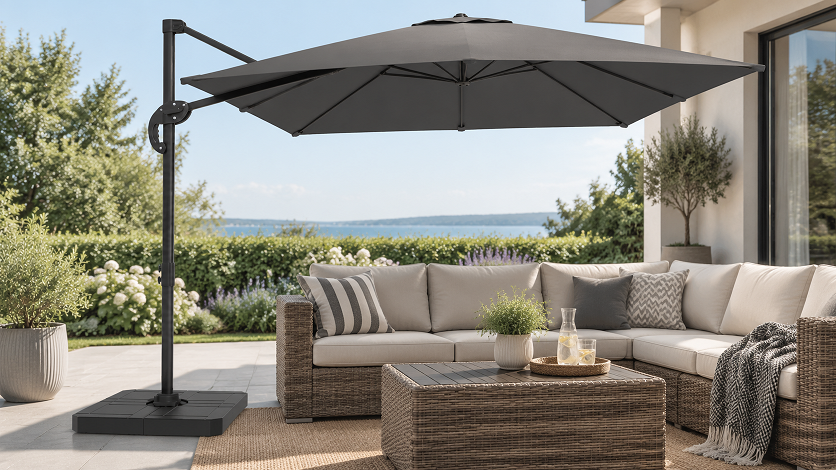
Among modern European outdoor parasols, the cantilever parasol has become one of the most important product types. It is also commonly known as an offset parasol, cantilever umbrella or banana parasol.
A traditional centre-pole parasol has its support pole directly beneath the canopy. This makes it well suited to garden tables with a central parasol hole. However, it becomes less practical when users need to shade an outdoor sofa, sun lounger or dining table without a centre opening.
The pole can interrupt the usable space and limit furniture placement.
The cantilever parasol solves this problem by moving the supporting structure to the side. The canopy can then extend over a seating or dining area without placing a pole in the middle.
This provides a broad shaded area while keeping the space beneath the canopy open and easier to use.
The growing popularity of cantilever parasols shows that European consumers no longer want only a patch of shade. They increasingly expect outdoor areas to feel complete, comfortable and flexible.
Cantilever parasols are especially well suited to:

Garden sofa areas
Outdoor sun loungers
Terrace seating
Dining areas
Poolside spaces
Large patios and gardens

From a product perspective, the cantilever parasol represents the development of the parasol from a basic shade tool into a more advanced outdoor furniture accessory.
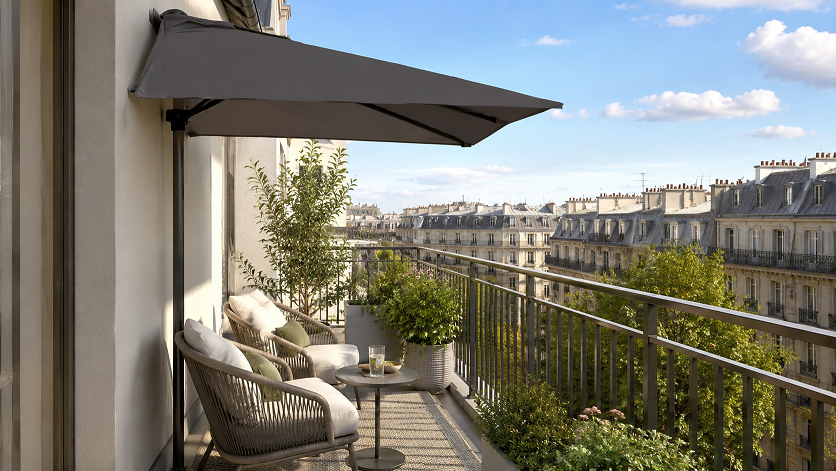

Balcony and Half Parasols: Designed for European Small-Space Living
Not every European household has a large garden or spacious terrace. Many homes have balconies, compact patios or narrow outdoor areas where a large centre-pole or cantilever parasol would be difficult to use.
This is why balcony parasols and half parasols have become important product categories.
A half parasol is usually designed to sit close to a wall. Rather than using a complete round or square canopy, it features a semicircular or half-width shape. This reduces the required floor space and makes it suitable for apartment balconies, narrow patios, small gardens and urban homes.
The development of these products reflects another important trend in the evolution of the European parasol: a move from large-area shade towards solutions designed for compact spaces.
Modern European consumers may not have expansive gardens, but they still want to create a small outdoor corner for coffee, reading, breakfast or a short break.
Balcony parasols are designed specifically for this type of use.
Their main benefits include:
Saving space
Sitting neatly against a wall
Suitability for apartments and smaller homes
Making balconies more usable
Allowing urban residents to enjoy outdoor living
From a product perspective, the half parasol represents the evolution of the parasol from traditional garden shade into a practical solution designed for compact outdoor spaces.
Functional Development: From Shade Product to Outdoor Comfort System
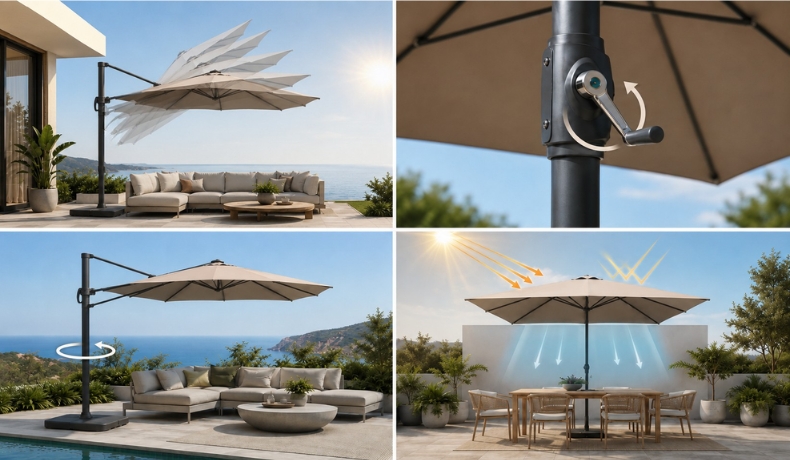
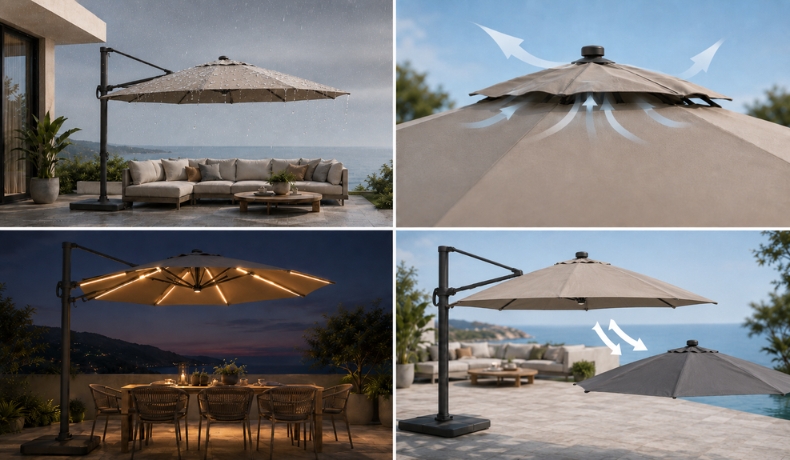
In the 21st century, the European outdoor parasol is no longer a simple shade product. It has gradually become part of a wider outdoor comfort system.
Common modern functions include:
- Adjustable tilt angles to follow the changing direction of the sun
- Crank mechanisms for easier opening and closing
- 360-degree rotation for a wider shaded area
- UV-resistant fabrics to reduce exposure to strong sunlight
- Water-repellent or light-rain-resistant canopies for changeable European weather
- Top vents to improve airflow and wind performance
- Solar LED lighting for evening atmosphere
- Removable, washable or replaceable canopies to extend product life
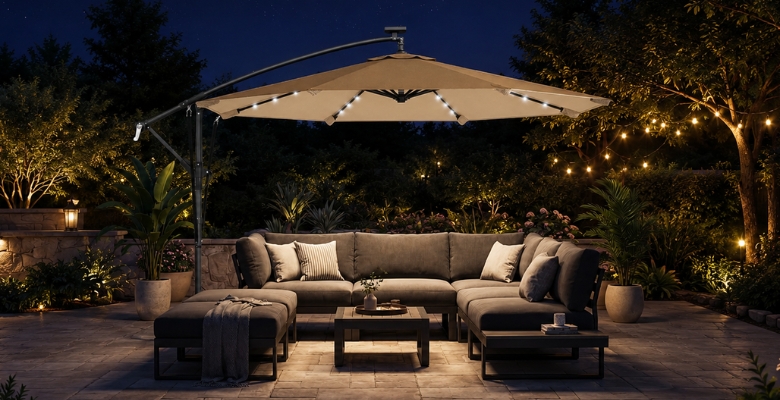

Solar LED parasols are a particularly clear example of this functional development.
During the day, they provide shade. In the evening, lighting installed along the ribs creates a warm atmosphere across the patio or garden. For many households, the parasol has therefore become part of outdoor dining, social gatherings and relaxed summer evenings.
The functional boundaries of the parasol have expanded considerably. It no longer serves only during the daytime, but continues into the evening and night.
It no longer addresses only sunlight. It also contributes to the comfort, usability and atmosphere of the entire outdoor space.
Conclusion:
The evolution of the European parasol reflects a broader transformation in the way people experience outdoor spaces. From a symbol of power and status in ancient times, to a fashionable accessory in the 17th and 18th centuries, and finally to an essential part of modern gardens, terraces and balconies, parasols have continuously adapted to changing lifestyles.
Today, a parasol is no longer only designed to block sunlight. With improved structures, weather-resistant materials and innovative functions, it has become a key element in creating comfortable, flexible and enjoyable outdoor environments.
Whether for a spacious garden, a cosy balcony or a relaxing terrace, modern parasols offer solutions for different spaces and needs — helping people extend their living areas beyond the walls of their homes and enjoy outdoor moments in greater comfort.
References:
1. Farrell, Jeremy. Umbrellas and Parasols.
London: Victoria and Albert Museum Publications / Costume Society, 1985.
2. Sangster, William. Umbrellas and Their History.
London: Cassell, Petter, and Galpin, 1855.
3. Beaujot, Ariel. Victorian Fashion Accessories.
Oxford: Berg Publishers, 2012.
4. Byrde, Penelope. Nineteenth Century Fashion.
London: B. T. Batsford Ltd, 1992.
5. Cumming, Valerie; Cunnington, C. W.; Cunnington, P. E.
The Dictionary of Fashion History.
Oxford: Berg Publishers, 2010.
6. The Victoria and Albert Museum (V&A).
Collections and historical resources on European fashion accessories, umbrellas and parasols.
London, United Kingdom.
7. The National Trust.
Historical references on British gardens, outdoor living spaces and traditional garden environments.
United Kingdom.
8. The Royal Horticultural Society (RHS).
Resources on British garden design, outdoor spaces and garden lifestyle development.
United Kingdom.
London: Victoria and Albert Museum Publications / Costume Society, 1985.
2. Sangster, William. Umbrellas and Their History.
London: Cassell, Petter, and Galpin, 1855.
3. Beaujot, Ariel. Victorian Fashion Accessories.
Oxford: Berg Publishers, 2012.
4. Byrde, Penelope. Nineteenth Century Fashion.
London: B. T. Batsford Ltd, 1992.
5. Cumming, Valerie; Cunnington, C. W.; Cunnington, P. E.
The Dictionary of Fashion History.
Oxford: Berg Publishers, 2010.
6. The Victoria and Albert Museum (V&A).
Collections and historical resources on European fashion accessories, umbrellas and parasols.
London, United Kingdom.
7. The National Trust.
Historical references on British gardens, outdoor living spaces and traditional garden environments.
United Kingdom.
8. The Royal Horticultural Society (RHS).
Resources on British garden design, outdoor spaces and garden lifestyle development.
United Kingdom.
Dr. James Taylor
Dr. James Taylor specializes in outdoor living spaces and garden furniture design tailored to maritime temperate climates. His work focuses on the design of shading structures, the optimization of outdoor living areas, and material performance under British and European weather conditions. He regularly collaborates with horticultural institutes, landscape designers, and garden equipment manufacturers in the UK, providing expertise on parasol selection, structural integrity, and the practical layout of residential terraces and balconies.